



This unique episode explores the companionship and care that service animals can provide for their owners. Today Dannelle speaks with Client Services Manager Aubree Wright and Client turned Instructor Assistant Makenzie McGuire from Canine Companions, a national organization that’s making a huge impact in the lives of people with a variety of needs and abilities by providing highly trained service dogs at no charge to the recipient. These amazing dogs go beyond the companionship that pets provide. From opening doors and picking up dropped items, to emotional support and helping to reduce stress and anxiety, service dogs can help their owners live more independent and fulfilling lives.
Guest Links
- Canine Companions
- Website: Canine Companions
- Instagram: @CanineOrg
- Twitter: @CanineOrg
- TikTok: @canineorg
- Facebook: @caninecompanions
- YouTube: @CanineCompanions
- Makenzie:
- Instagram: @kinzie09
- Aubree:
- Instagram: @aawwwwright
About Aubree Wright
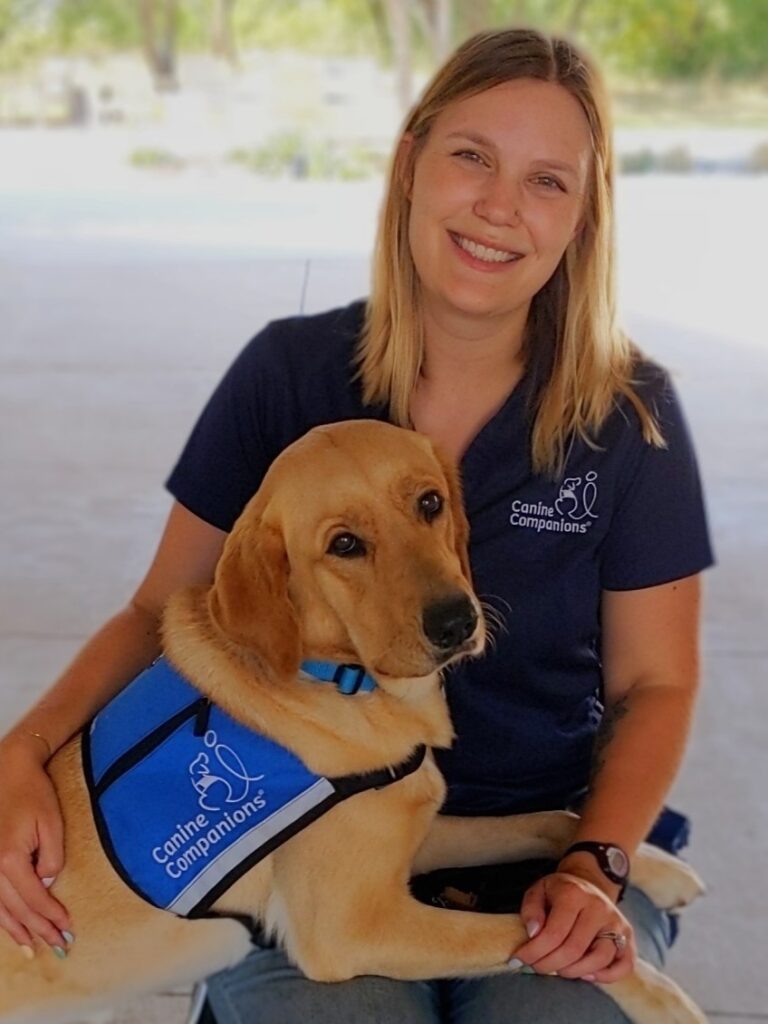
Aubree Wright is the Client Services Program Manager for the South-Central region of Canine Companions and trains service dogs to prepare them for ownership. Canine Companions is leading the service dog industry so their clients and dogs can live with greater independence. They provide service dogs to adults, children and veterans with disabilities and facility dogs to professionals working in healthcare, criminal justice and educational settings. Since their founding in 1975, their dogs and all follow-up services are provided at no cost. They serve adults, children, veterans, and professionals working in healthcare, visitation, criminal justice and education settings.
About Makenzie McGuire
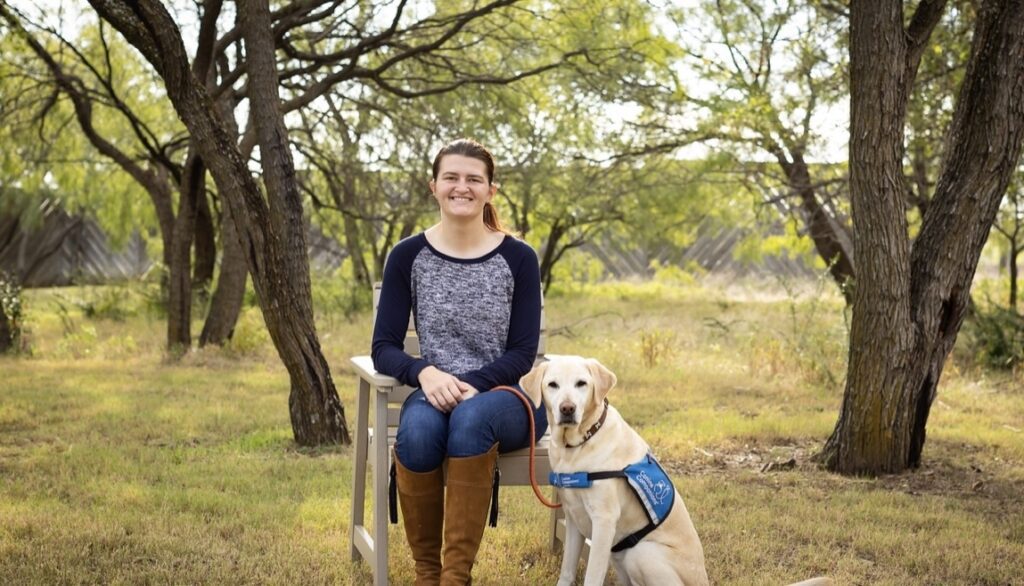
Makenzie McGuire has been deaf since birth and received her first cochlear implant when she was 2. Makenzie applied for a hearing dog with Canine Companions and got matched to Hanalei in May of 2017. She later became an Instructor for the company.
Transcript
[00:00:03] Aubree: Canine Companions is a nonprofit organization and we provide service dogs to people with disabilities nationwide, and they’re provided free of charge. So, we provide assistance dogs to people with physical disabilities, veterans with PTSD, as well as we work with professionals to provide facility dogs to work with larger populations of either people with disabilities or victims of crime. So, we kind of have our hands in a lot of different pots and it’s, it’s definitely a good thing. We get to touch a lot of lives.
Read More
[00:00:37] Dannelle: This episode is a little different than what we’ve done so far on The Caregiving Soul. Today we’re exploring beyond human-to-human care relationships to shine a spotlight on Canine Companions, a national organization making a huge impact in the lives of people with a variety of needs and abilities by providing highly trained service dogs at no charge to the recipient.
[00:01:05] These amazing dogs provide support beyond the companionship that our everyday pets can provide. From opening doors and picking up dropped items to emotional support and helping to reduce stress and anxiety, service dogs can help their humans live more independent and fulfilling lives.
[00:01:29] Client Services manager Aubree Wright and client turned instructor assistant Makenzie McGuire are here to discuss how these relationships have impacted them and others.
[00:01:45] Welcome to The Caregiving Soul. I’m Dannelle LeBlanc.
[00:01:52] [Music Ends]
[00:01:52] Dannelle: Can you tell us a little bit about how you got here? How did you connect with and start to work with Canine Companions?
[00:02:01] Aubree: My journey started in marine biology actually. So, my degree is in marine biology, where after college I did some internships and worked with marine mammals. There in my internships is where I kind of learned that I’d like to do something more impactful. So, in 2016 I started with Canine Companions, and that’s where I started my apprenticeship. Four years later I became an instructor. And then now I’ve moved into this role, which is the client services program manager, now I get to not only work with applicants, but the folks who are placed with the dogs and get to see kind of the start of their journey and how they’re able to be long-term assisted by these dogs that we train and provide to them, so.
[00:02:46] Dannelle: That is amazing. But I wanna ask Makenzie the same, how did you connect with Canine Companions, Makenzie?
[00:02:54] Makenzie: So, I actually am deaf in both ears and have cochlear implants, bilateral cochlear implants. So, it was back in high school when I was trying to figure out, okay, I’m gonna be going off to college and I need a way to safely be able to go to college. And I had tried all the different alarms, like the bed shake, awake alarms, the strobe fire alarms, all those different types of things. And none of them had worked.
[00:03:18] So, I started doing some more research because I knew I couldn’t depend on other people like I could depend on my parents. I wouldn’t be able to depend on my roommates in that same way, and I didn’t want to have to depend on other people like that. And so, when I started doing research, I found out about hearing dogs, and that’s where I saw Canine Companions.
[00:03:39] So, I decided to apply for a hearing dog from them and I ended up getting accepted onto the list and then getting my hearing dog in May of 2017. And then I had gone off to college with Hanalei and Hanalei gave me the ability to be able to go to college completely independent.
[00:03:57] And then while I was in college I was doing some animal science degrees and I decided that – I saw a position open up at Canine Companions and I wanted to be able to play a part in helping other people experience the same independence I had gained. So, I came and started working for Canine Companions.
[00:04:14] Dannelle: Oh, I love that. So, I mean, that is perfect example of quality of life, how the dogs help people to maintain their independence and to increase quality of life. So, um, oh, and I just wanna ask, is Hanalei there with you. Can we say hi?
[00:04:35] Makenzie: Yes, she is. Come here. So, this is Hanalei. [Laughs]
[00:04:41] Dannelle: Hi Hanalei! We’re so glad you’re here. Thank you so much for being on The Caregiving Soul [Laughs]
[00:04:48] Makenzie: [Laughs]
[00:04:50] Dannelle: So, you talked a little bit about some of the reasons why people seek out service dogs for support, but I think for many people, especially if they don’t already have a dog, then it may not occur to them. We had our family dog but it never, it would’ve never even occurred to me to think of a service dog to help in some way. So, how does that happen? What are some of the other reasons why people would seek out and benefit from a service dog for support?
[00:05:28] Aubree: In general, we serve individuals. So, every person has their own story and their own reasoning behind wanting to get any kind of service animal in their life. So, there’s definitely a lot of folks that we have served and will continue to serve. But I know just some little examples.
[00:05:48] A lot of our veterans, they don’t enjoy going into public places. They’ve had a lot of trouble with re-assimilating into this society. And having a service dog with them, not only can help them be a little bit more confident in their own abilities, but just kind of be environmentally aware in a way that’s safe and familiar to them.
[00:06:10] We do provide task work where the dog will like just stand in front of the veteran or behind them so they can feel a little bit more comfortable in those public spaces that they might not normally. The dogs also provide anxiety interruption, so it’s almost like this partner in their life is hopefully trained to become so attentive to this individual that they can recognize these certain cues or triggers in this person’s repertoire of their kind of day-to-day.
[00:06:38] So, if they start bouncing their leg when they’re sitting in a meeting or something like that, the dog will come up and kind of indicate, “Hey, uh, excuse me, I, I think you’re, you’re feeling something there” so they can kind of redirect their thoughts. And I think that’s really important, just that particular example.
[00:06:55] Otherwise, you know, just having the dog help with activities of daily life, retrieving dropped items, opening a, a door, having the ability to, like in Mackenzie’s case, go out into public and not feel like she’s not gonna hear somebody call her name, or her cell phone’s gonna ring and she’s gonna miss an important call. The dog’s gonna be right there to you know, help in that particular way to really make them be able to be accountable in their own way and not feel like they need other people to really help them.
[00:07:25] When we work with our professionals, they’re really helping, uh, a, a vast variety of clients and patients, and individuals there. So, for them, I feel like, their goals can be as much as it is maybe hard for somebody to go through a rehabilitation process after going through an accident, the dog can be there to motivate, that client or patient to do one more rep or do one more step. That kind of thing really kind of helps.
[00:07:52] And when a furry [Laughs] cute furry animal’s looking at you, you wanna do that much more than just if your, your nurse, or child life specialist or your rehabilitation doctor is like, “Hey, you can do one more”. They’re like, “No, no, no”. But if a dog’s there you’re like, “I’m gonna do as much as I can to be with this dog for as long as I can”. So, they can really touch a lot of lives there.
[00:08:14] Dannelle: Yes. And in so many different ways. Dogs can help and support someone in a way that sometimes we humans are less attuned to.
[00:08:23] Aubree: Absolutely.
[00:08:24] Dannelle: So, Makenzie, tell us a little bit more about your relationship with Hanalei?
[00:08:34] Makenzie: Yeah, absolutely. So, the relationship, I mean, it’s, [Music] she is basically my lifeline. That’s the way that I always view her, is that she’s my lifeline. She has, on several occasions, proven that she could and would save my life cuz like when you’re in the college dorms, fire alarm goes off, and at night a lot, because people don’t know how to cook in those storms and they set off the fire alarms a lot.
[00:08:58] Dannelle: [Laughs]
[00:08:58] Makenzie: And yeah, unfortunately that is a thing and you get up at midnight, but I wouldn’t have gotten up in the first place if Hanalei wasn’t there to wake me up. And so, in the case of that being a real fire, then I would’ve still abandoned the dorm and there’s no telling what could have happened. But Hanalei was right there to get me up and get me out.
[00:09:19] And when I’m out in public, just watching her body and reading her body language, it makes me feel so much safer because I can tell when people are coming up behind me, especially walking around campus at night by myself, all that type of stuff. She wouldn’t necessarily protect me or anything, but she makes me aware of the people around me cuz I can’t hear behind me with my implants. So, it’s a huge safety aspect.
[00:09:43] And then when she is off duty, she is always there wanting to cuddle, and we have an amazing relationship where we just trust each other. And even though they are our working dogs and we have that working relationship, we still have that relationship with them like a normal pet owner would have. It’s just I feel like sometimes on a higher level because you’re working day in and day out with this dog.
[00:10:08] [Music Ends]
[00:10:10] Dannelle: Yeah.
[00:10:10] Aubree: Um, I’m sorry to interrupt, Dannelle, but –
[00:10:12] Dannelle: Yes?
[00:10:12] Aubree: I really do want Makenzie to tell you her first impressions of Hanalei. Um, when we match our, our clients with our dogs, we kind of have them with different types of dogs and her, I think, first impression was very notable, and I think just the evolution of their relationship now is, is important to touch on too.
[00:10:33] Dannelle: Yes, please tell us.
[00:10:35] Makenzie: Yeah, so it was back in team training when we were working, you have different dogs that you work with each day and the way that I knew that Hanalei was mine was our instructor was with the hearing dogs, they go into a little apartment set up. Our instructor was sitting, laying on the couch demonstrating how the dog would alert to a sound and the sound goes off – and while they’re training and learning to match with us, we tell them to alert to the sounds to kind of get them used to it.
[00:11:00] So, she was showing us how to start doing that and she told Hanalei “Alert” and instead of going to alert the instructor, she came over and alerted me and so from that moment on, I was like, “Yeah, this my dog”. And ever since then she refuses to alert anyone else and she always looks for me to alert.
[00:11:17] Dannelle: Really?! So, on some level that almost sounds like she knew.
[00:11:23] Makenzie: Mhmm.
[00:11:25] Dannelle: Wow.
[00:11:27] Makenzie: Yeah, it’s amazing.
[00:11:28] Dannelle: That is amazing. So, you have dogs that are specifically trained as hearing dogs. What other kinds of training and support can the dogs provide?
[00:11:43] Aubree: So, in the beginning of their life at eight weeks old, they’re given to a volunteer who helps really build that foundation for our dogs. So, somebody in the community will take their dog, do the socialization, really introduce those basic commands that will need to build their skills as a service dog.
[00:12:02] They’re in professional training with an instructor or a qualified trainer for six to nine months, and probably within the first three months we really do kind of hone in on their strengths and weaknesses to understand exactly what type of placement and, and what type of person really is. So, there is an extensive training process.
[00:12:20] And, it really depends if a dog is really strong with their impulse control and their reliability, that might make a really good service dog that does physical task work where they’re picking up dropped items for their handler and they’re tugging open heavy doors and drawers and, and pushing those automatic push plates. Some dogs that might be kind of higher energy and maybe have a little bit more intuitiveness and independence benefit most from that hearing dog program. So, definitely a lot of different pieces and parts that go into that process.
[00:12:53] Dannelle: I’m just amazed at the process and how much work is involved and just the relationship that it creates with these service dogs. Makenzie, on top of working with Canine Companions, you’ve now become an instructor assistant. Can you share a little bit more about what that has been like so we can better understand what it’s like for, for the trainers?
[00:13:25] Makenzie: Absolutely. So, instructor assistant is the first step to becoming a, a fully certified instructor, and that’s basically six months of shadowing the trainers and learning what it takes to train a dog and getting to see all the different personalities and how their trainers work with the different personalities, cuz one dog might excel with this type of training technique versus another dog, you have to use a different training technique. So, you really get the chance to watch and learn a lot.
[00:13:55] And you get to learn about Canine Companions as a whole because you get the opportunity to rotate through to different departments, is what they call it. So, you learn about the puppy raising side of it. You learn about the client services and graduate follow-up, the applicant follow-up. You learn about marketing and volunteer departments; all the different departments and they’re also teaching you a lot.
[00:14:17] There’s a lot of educational materials and stuff that you get the opportunity to learn and you’re just, it’s a whole learning process and it’s not just the instructor assistant that it starts with, it’s through the entire apprenticeship course that they have for you to just help you build on your skills and be prepared to be able to train some of the, uh, highly skilled service dogs that Canine Companions provides.
[00:14:40] Dannelle: Oh, that is just so wonderful. So, Aubree, you talked about the impact that this makes on the people who are supported by these dogs. Can you share a story with us about what it was like for someone from the beginning of their journey when they were first matched with and connected with their service dog and the impact that it made on their life, how it changed their quality of life?
[00:15:14] Aubree: I’ve seen a lot of people come through this process and every single time we have a team training, it just makes me that much more motivated to do my job better, and there’s so many examples that I can think of just from all different types of placements that really have transformed my understanding.
[00:15:35] And, I think one in particular I can think of was [Music] we had this one woman who has cerebral palsy and she really just didn’t have a ton of just general independence in her own life. And she is a younger woman, just, you know due to her disability the daily living things were, were really challenging for her. I was able to be a part of her application process as well, just as an apprentice myself.
[00:16:04] I think when we were looking at her application materials, it was gonna be a challenging placement just because we had to be really particular about which dog we put with her. So, when she came to class, I was truly honored to be one of the in instructors of this class, and I actually trained the dog that she was matched with.
[00:16:24] And it was truly like one of those magic moments. I, I would suppose, similar to what Makenzie said, this dog, in a way, I think chose her handler, and like the mom was there like helping and she was in tears. Like we were all –
[00:16:38] Dannelle: Wow!
[00:16:38] Aubree: – just like, we can’t, we can’t train this kind of thing. And now I’m able to see her as a graduate and she’s able to go to the mall without just having somebody accompany her the whole time because she has her dog there to be able to help with, with any little thing, right? Like, if, if she does drop her cell phone, like the dog’s there to help her.
[00:16:59] You know, not everything in her life is changed or solved, but she’s able to be this more outgoing, and really social human now because she has this dog with her to truly boost her confidence and independence in a way that I don’t think any other person could ever help with. [Laughs]
[00:17:20] So I, I really love seeing that, that. And it’s, it’s really, it’s really amazing to see some of these partnerships and building these relationships is so important to us, and those lasting really meaningful relationships are what matters.
[00:17:35] [Music Ends]
[00:17:35] Dannelle: And to touch on something that Makenzie said earlier, from a caregiving perspective, it is a beautiful thing for someone who needs some kind of assistance to be able to receive that, and to maintain independence and to not feel like, you know, Makenzie, you were talking about, when you went away to college, you wanted to be able to do that and not have to depend on your roommates. And them wanted to be able to have autonomy over your ability to do whatever it is you needed to do at whatever time and whatever circumstance.
[00:18:18] And that is just, really beautiful and important. And I’m just again, just in awe of this work. Gosh! [Laughs] So, what else do we need to know about you guys and these sweethearts and Canine Companions? What else do we need to know?
[00:18:42] Aubree: Well, there’s definitely a lot more to learn. We, we like to say it absolutely takes a village to provide these dogs, when it comes to not only like funding capability of providing these dogs free of charge. So, any kind of donor, volunteers, we always need folks that are willing to puppy raise. That’s such an important piece of how we can provide these dogs to folks.
[00:19:07] And then of course, applicants and graduates. We are always looking for folks that are interested in starting this partnership with a service dog. So, there’s definitely a lot of ways to get involved. There’s definitely a lot of information out there about service dogs. And of course just being a good ambassador for service dogs, people with disabilities as a whole, and just being a good human is always [Laughs] a good piece of that as well.
[00:19:35] I think in general we, we like to say we’re building relationships here and it is all about cooperation between a dog and a person. And if someone’s interested in learning more, we have a website and a lot of different contact information to, to just learn more about the program too.
[00:19:53] Dannelle: And we’re gonna be sure to provide links and resource links to all of your information in our show notes for certain.
[00:20:01] Aubree: Awesome.
[00:20:02] Dannelle: Makenzie, what about you? What else would you say that we need to know about Canine Companions and this experience?
[00:20:11] Makenzie: So, I think something that, really makes Canine Companions pretty unique is the community that comes behind these dogs. It is really a giant family that comes together across the entire nation to make it all happen, whether it be the graduates that are the family, the puppy raisers that are family.
[00:20:29] I still talk to Hanalei’s puppy raiser all the time, and the puppy raisers usually keep in contact with the graduates and you gain another extended family when you get a Canine Companion dog or you gain another person in your family when you raise a Canine Companion dog.
[00:20:43] When you’re traveling, you can post on some of the social medias and stuff and you’ll be able to find people in that area you’re traveling to that are Canine Companion people, and they’re willing to help you out if you need help there. It’s just this huge community that comes together to support the mission of getting people independence and everyone works together to try and be there for each other and just create this huge family is what it comes down to being.
[00:21:10] Dannelle: I just love this so much.
[00:21:13] Aubree: I know I’m going to champion for Makenzie to get a raise. She’s like –
[00:22:16] Makenzie: [Laughs]
[00:21:16] Aubree: – really [Laughs] She’s really doing good with her, with her promotional information that she’s learning. And I think being a graduate too I can imagine, like she’s been such a great graduate and like, so well informed and in a way that she’s really providing just this really great life for her dog too.
[00:21:38] So, I think, you know, when we’re talking about how important this is, it’s not just like this dog is changing Makenzie’s life. I think Makenzie’s also changing this dog’s life in a way that really helps benefit both of them. And I’ve seen Makenzie and Hanalei work together and it’s really just a very beautifully choreographed dance and it’s just wonderful. And, and they just are such a great partnership.
[00:22:01] Dannelle: I am 100% behind that, and it is mutual. And I think that that’s why it works –
[00:22:08] Aubree: Mhmm.
[00:22:09] Dannelle: – is because it’s, it, cuz it’s a mutual benefit.
[00:22:12] Makenzie: I mean the dogs, you can tell they love to work. A lot of these dogs, if they didn’t have this job, they wouldn’t be happy. I know Hanalei loves her job. Her tail is wagging and going and she just jumps up and is so excited when a sound goes off. I mean these dogs absolutely love to work, so it is very mutual of, they need that job to be happy.
[00:22:32] Dannelle: It’s fulfilling for their lives as well. Yes! Cause everybody wants to feel like their life matters, and it doesn’t matter whether you’re a human being or an animal. You guys are lovely human beings. Thank you so much for joining us today on The Caregiving Soul. It was so wonderful to have you.
[00:22:57] Aubree: Thanks Dannelle, it was a pleasure talking with you and you are also a wonderful human being and I’m thankful that you do what you do, cuz no one would know about any of this stuff without you guys. So we, we appreciate being here.
[00:23:10] Makenzie: Yeah, we definitely appreciate it. Thank you.
[00:23:12] [Music]
[00:23:16] Dannelle: Thank you for joining our conversation with Aubree and Makenzie.
[00:23:21] The incredible impact that these dogs have had on the lives of their humans is life changing. These relationships provide support unencumbered by human judgment or assumptions. A service dog doesn’t care about the details of our lives. They find joy in supporting us in whatever way we need. That can be incredibly freeing and empowering. The bond between humans and their Canine Companions demonstrates the power of our potential when we receive the right kind of support.
[00:24:02] Check out our show notes to connect with and follow Canine Companions.
[00:24:08] Every episode of The Caregiving Soul has a page on empoweredus.org where you can find the extended show notes, including tips and takeaways, transcripts, and relevant resource links.
[00:24:21] For additional bonus content from this episode, and to connect with us, be sure to follow the Empowered Us social channels on Instagram @empoweredusnetwork and Twitter @empowereduspod.
[00:24:37] The Caregiving Soul is an Empowered Us original, presented by Good Days, hosted by me, Dannelle LeBlanc. If you liked this episode, be sure to rate and subscribe to the show wherever you get your podcasts.
[00:24:53] And remember, the right care includes care for you.
[00:25:04] [Music Ends]
Read Less
Recommended this Week

How to care for people with neurological diseases by putting the relationship first and speaking their “language”.

How to celebrate caregivers and navigate caregiving as a young adult.